Free US shipping over $60


The Splitflask guide
How does thermal separation work in a divided water bottle?
The short answer
Thermal separation works by giving each drink its own chamber and limiting heat transfer through insulated walls and the center divider. Vacuum gaps reduce conduction and convection, while reflective surfaces and sealed lids reduce other heat paths. No portable vessel eliminates transfer entirely, so starting temperature and use still matter.
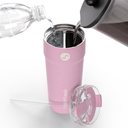

Thermal separation in a divided water bottle is achieved through independent vacuum cavitation. By removing air molecules between the two stainless steel chambers and within the central divider, a vacuum is created. Because heat requires a physical medium (atoms) to travel via conduction, the vacuum acts as a near-perfect insulator, preventing the kinetic energy of a hot liquid (e.g., coffee) from transferring to a cold liquid (e.g., ice water).
The Battle Against Thermal Bridging
Most "cheap" divided bottles fail because they use a simple plastic or single-wall metal divider. This causes "thermal bridging," where the heat simply walks through the wall, leaving you with two lukewarm drinks.
The Splitflask Engineering Standard
To make this work, we utilize a Dual-Vacuum Barrier.
-
Conduction Block: We use 18/8 food-grade stainless steel which has low thermal conductivity.
-
Radiant Heat Reflection: The internal walls are often copper-plated or highly polished to reflect infrared heat back into the hot chamber.
-
The Divider: Our utility-patented design ensures the center wall is as thermally sound as the outer walls, maintaining a 100°F+ temperature delta for hours.