FREE STANDARD US SHIPPING ON ALL TUMBLERS


The Splitflask guide
What Is the Best Tumbler for Nurses Who Carry Coffee and Water?
The short answer
For a nurse who routinely carries both coffee and water, a dual-chamber tumbler can be a strong fit because it keeps both drinks separate in one footprint. The best choice still depends on workplace rules, cleaning access, capacity, lid operation, and where the cup can be stored safely.
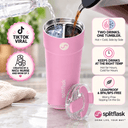

For a nurse who routinely carries both coffee and water, a dual-chamber tumbler can be a strong fit because it keeps both drinks separate in one footprint. The best choice still depends on workplace rules, cleaning access, usable capacity, lid operation, stable placement, and where personal drinks may be stored.
No single tumbler is best for every nurse or facility. A useful comparison begins with the actual routine: where the cup stays, how often it can be refilled, whether warm drinks are permitted, and how the vessel will be washed between uses.
Why carry coffee and water together but separately?
A coffee cup and a water bottle occupy two spaces and create two items to move between a bag, locker, break area, and approved workstation. Pouring them together is not a solution. A divided tumbler gives each beverage an independent chamber while combining the exterior.
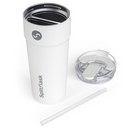
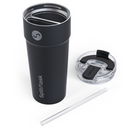
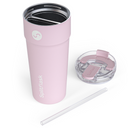
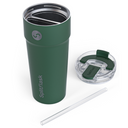
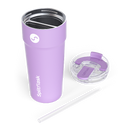
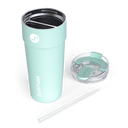
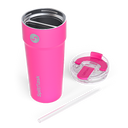
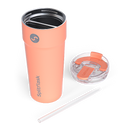
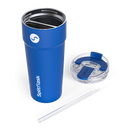
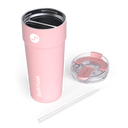
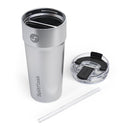
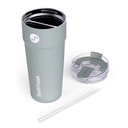
Splitflask provides two 15 oz chambers in one 30 oz body. That can work well for someone who values both drinks in moderate amounts. A person who needs substantially more water between refills may prefer a larger dedicated bottle, so capacity should be evaluated honestly.
What should nurses compare in a tumbler?
| Criterion | Why it matters during a shift |
|---|---|
| Workplace policy | Facilities may restrict where personal drinks can be stored or consumed |
| Stable footprint | A secure placement area matters around paperwork and equipment |
| Per-side capacity | Each chamber must hold a useful amount between refill opportunities |
| Deliberate lid operation | The user should be able to identify and close each drinking path |
| Cleaning access | Coffee oils, additives, seals, and lid channels require complete washing |
| Leak-resistant assembly | Correctly seated seals reduce ordinary carrying spills |
| Bag and vehicle fit | The tumbler still has to travel safely before and after work |
How does a two-drink tumbler fit a shift routine?
One approach is to assign coffee to the same chamber every day and water to the other. A consistent orientation makes it easier to identify each lid opening and remember which path needs extra attention during cleaning.
Before leaving home, inspect the removable seals, avoid overfilling, and close both drinking paths according to the instructions. At work, place the tumbler only in a permitted, stable location. Refill and consume beverages according to your own needs and applicable guidance rather than treating the vessel's capacity as a hydration recommendation.
Can one side be warm and the other cold?
Independent vacuum-insulated chambers limit direct temperature transfer, allowing warm coffee and cold water to remain in separate environments. Real-world temperature changes still depend on initial temperature, ambient conditions, lid openings, ice, and fill level.
Use the product's approved temperature range and drinking configuration. Handle hot beverages carefully, and do not rely on a fixed retention promise that was not established through a documented product-specific test.
What cleaning routine works for coffee and water?
- Empty both chambers when the shift is over.
- Disassemble removable lid components according to the care guide.
- Wash the coffee reservoir, its drinking path, threads, and seals thoroughly.
- Wash the water chamber and second path rather than assuming a rinse is enough.
- Inspect components for residue, wear, or incorrect seating.
- Dry all parts completely before storage or reassembly.
Milk, creamer, sweetener, and flavored coffee can create additional residue and food-safety considerations. Prompt cleaning is essential, and insulation does not make perishable ingredients safe indefinitely.
When is a conventional bottle a better option?
A single-chamber water bottle may be better if maximum water capacity is the priority, coffee is not allowed, or the facility's policy favors a particular closure or storage method. Two separate containers may also make sense when the drinks need to be placed in different locations.
The relevant advantage of a dual-chamber tumbler is not that every nurse needs one. It is that a nurse who already carries two drinks can place them in one exterior while preserving separation.
For the general setup, see how coffee and water can travel in one tumbler.
Frequently asked questions
Does a dual-chamber tumbler replace every work bottle?
No. Capacity, workplace policy, cleaning facilities, and drink preferences vary. It is one option for a specific two-drink routine.
Will coffee make the water taste different?
Independent chambers keep the liquids apart. Coffee residue on an inadequately cleaned lid or gasket can still affect aroma, so every contact surface should be washed.
Can the tumbler sit at a nursing station?
That depends on the employer and the designated area. Follow facility policy and keep personal drinkware only where it is explicitly permitted.
Is 15 oz of water enough for a shift?
One chamber is not presented as a complete shift-long intake. It can be refilled when permitted, or both chambers can hold water when coffee is not needed. Individual needs vary.
The bottom line
For nurses who already bring coffee and water, a well-designed dual-chamber tumbler can reduce container clutter. Compare policy, per-side capacity, stable storage, lid control, cleaning access, and travel fit before deciding.
See the Splitflask two-drink tumbler and current availability.