Free US shipping over $60


The Splitflask guide
How Long Does Ice Stay Solid in a Tumbler Inside a Hot Car?
The short answer
There is no single reliable answer without a controlled test. Ice life in a hot car changes with cabin temperature, ice mass and shape, starting water temperature, sunlight, cup placement, lid openings, and insulation. Treat any fixed hour claim as product- and test-specific, not a guarantee for every car or day.
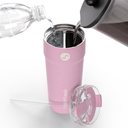
A parked car is an uncontrolled heat chamber. Cabin temperature changes with weather, sunlight, glass area, interior color, airflow, parking angle, and time. Tumbler performance changes too, so a fixed “ice lasts X hours” answer without test conditions is not trustworthy.
What determines how quickly ice melts?
- Cabin temperature: a hotter temperature difference drives heat into the drink faster.
- Direct sun: radiant heat on the cup and lid can be more demanding than shaded cabin air.
- Ice mass and shape: one large piece usually exposes less surface area than the same mass of crushed ice.
- Starting liquid temperature: room-temperature water uses ice simply to cool itself.
- Ice-to-water ratio: a mostly full cup of ice behaves differently from a few cubes.
- Fill level and lid: air space, an open straw, and lid material affect heat transfer.
- Opening frequency: every inspection or sip admits hotter air.
- Insulation condition: damage to the vacuum wall can sharply reduce performance.
Honest answer: ice lasts until the specific heat entering that specific tumbler melts it. Without the starting conditions and measurements, an hour number is marketing—not a reproducible result.
How to run a fair hot-car tumbler test
A controlled test gives shoppers useful evidence and makes future comparisons possible. Never remain inside a parked hot car to monitor it.
- Weigh the empty, dry tumbler and lid.
- Add a recorded mass of the same ice shape and a recorded mass of chilled water.
- Measure the starting water temperature with a calibrated thermometer.
- Record the car location, shade or sun exposure, weather, cabin temperature, start time, and cupholder position.
- Close the lid in the normal configuration and do not open it during the main test.
- At the planned endpoint, move the tumbler to a safe location, separate remaining ice from water, and weigh the ice.
- Repeat the test on multiple days and report the range rather than only the best result.
| Record | Example format |
|---|---|
| Starting ice and water | Grams of each, plus ice shape |
| Starting temperature | Water °F and cabin °F |
| Exposure | Direct sun or shade; cupholder location |
| Elapsed time | Exact hours and minutes |
| Result | Remaining ice mass and final water temperature |
Is it safe to leave a tumbler in a hot car?
Still water and ice do not create the same food-safety concern as dairy or broth, but the container and its contents can still become extremely hot. Do not leave milk, soup, or another perishable drink in a parked car and assume insulation keeps it safe. USDA's limit is one hour for perishable food in ambient temperatures above 90°F when it is not maintained at a safe hot or cold temperature.
Never leave a carbonated drink in a hot vehicle. Warming releases more dissolved gas and increases pressure in a sealed container. Also avoid leaving medicines or anything else with temperature-sensitive storage requirements.
Before drinking, check for a lifted lid, distorted seal, leakage, excessive exterior heat, or damage. Open cautiously and away from your face.
How to help ice last longer
- Prechill the approved chamber with cold water, then empty it.
- Begin with cold drinking water instead of room-temperature water.
- Use enough ice and leave only the headspace required by the maker.
- Close the lid promptly and minimize openings.
- Keep the tumbler out of direct sun and take it with you rather than storing it in the vehicle.
Frequently asked questions
Does more ice always last longer?
More ice mass generally requires more incoming heat to melt, but shape and starting water temperature matter. Compare products with the same ice mass, ice type, water mass, and conditions.
Does crushed ice melt faster than large cubes?
Crushed ice exposes more surface area, so it typically exchanges heat with the water faster than the same mass in large pieces. It can chill quickly but is not an equivalent retention test.
Can the outside of a vacuum tumbler feel cool?
The body may remain near room temperature even with ice inside. Persistent sweating or a body that quickly becomes as cold as the drink can indicate lost vacuum performance; contact the maker.
How should a brand advertise an ice test?
Publish the ice and water mass, starting temperatures, ambient and cabin conditions, lid configuration, number of openings, elapsed time, and range across repeated tests. Avoid turning one favorable result into a guarantee.
The bottom line
Ice survival in a hot car has no universal hour count. Use a transparent, repeatable test for the specific tumbler, and keep the cup out of direct heat whenever possible. Never use remaining ice as proof that a perishable drink stayed food-safe.
Food-safety source: USDA Food Safety and Inspection Service, Danger Zone (40°F–140°F).