FREE STANDARD US SHIPPING ON ALL TUMBLERS


The Splitflask guide
Can You Put Carbonated Drinks in a Stainless Steel Bottle?
The short answer
Yes—but only if the bottle and lid are approved for carbonated drinks. Food-grade stainless steel generally tolerates sparkling water and soda, but trapped carbon dioxide raises pressure inside a sealed bottle. Leave headspace, keep it cool, avoid shaking, and open it slowly.
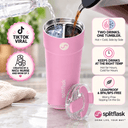

Sparkling water, soda, kombucha, and carbonated energy drinks all contain dissolved carbon dioxide. The steel body is rarely the weak point. Pressure collects in the sealed space above the drink, so the lid design and the manufacturer's instructions determine whether a bottle is appropriate.
What happens when you seal a carbonated drink?
Carbon dioxide stays dissolved more readily in a cold drink. As the liquid warms or gets shaken, more gas escapes into the headspace. In a closed container that gas cannot simply drift away, so internal pressure rises.
That pressure can create several problems even when the stainless steel body remains intact:
- A push-in lid can lift, leak, or release unexpectedly.
- A straw or drinking opening can spray when uncovered.
- A screw lid can become difficult to open and release liquid suddenly.
- Sugary residue can collect in threads, valves, and silicone seals after a leak.
The key distinction: a material may be compatible with a drink while the complete container is not pressure-rated for it. Check the instructions for the exact bottle and lid rather than assuming every stainless steel tumbler works the same way.
Will sparkling water or soda damage stainless steel?
Under ordinary beverage conditions, quality food-grade stainless steel is highly resistant to corrosion. The weak carbonic acid in sparkling water does not normally “eat through” an intact 18/8 stainless steel vessel during routine use. Soda adds stronger acids, sweeteners, and flavoring, which makes prompt cleaning more important even when the steel itself is compatible.
Look for a clearly identified food-grade grade such as 18/8 stainless steel, a smooth undamaged interior, and care instructions from the maker. Retire or have the vessel assessed if you see deep pitting, persistent rust, a damaged liner, or a seal that no longer fits correctly.
How to carry a fizzy drink more safely
- Verify approval first. Use carbonated drinks only when the manufacturer says the bottle and installed lid can handle them.
- Start cold. A cold drink generally retains dissolved carbon dioxide better than a warm one.
- Leave headspace. Do not fill to the very top. Follow the fill line or instructions for the vessel.
- Keep it upright and avoid shaking. Movement encourages foaming and makes the release less predictable.
- Keep it out of a hot car. Warming increases pressure and can stress the lid or seal.
- Open away from your face. Release the closure slowly over a sink or outdoors, allowing any hiss to subside before opening fully.
- Wash immediately. Remove sweetener, acid, and fermentation residue from the body, threads, gasket, straw, and valves.
Do not put an actively fermenting drink into a sealed bottle. Live fermentation can keep producing gas after filling, making the final pressure hard to predict.
What makes a good tumbler for carbonated drinks?
Begin with explicit carbonation approval. Then compare a mechanically secure closure, replaceable seals, easy-to-clean lid passages, a fill line that preserves headspace, and insulation that limits warming. A screw-on lid may resist lifting better than a simple push-in lid, but threads alone do not prove that a product is pressure-rated.
| Feature | Why it matters | What it does not prove |
|---|---|---|
| Food-grade stainless steel | Resists ordinary beverage corrosion and is easy to clean | That the lid can contain pressure |
| Vacuum insulation | Slows warming that can encourage gas release | A guaranteed number of fizzy hours |
| Threaded closure | Can provide a more mechanically secure attachment | Carbonation approval without manufacturer confirmation |
| Removable gasket | Makes sticky residue easier to reach | That every valve or straw is pressure-safe |
Frequently asked questions
Can you put Coke, Sprite, or another soda in stainless steel?
The steel is generally compatible with soda for normal serving, but the sealed container still needs manufacturer approval for carbonation. Wash all sugary residue out soon after use.
How long will soda stay fizzy in a tumbler?
There is no reliable universal time. Starting temperature, headspace, agitation, lid seal, and how often you open it all change the result. A product-specific test is more useful than a blanket four- or six-hour promise.
Why did my lid pop or spray?
Gas accumulated above the drink and escaped when the closure moved. Stop using that lid for carbonation unless the manufacturer confirms it is intended for pressure, and inspect the seal for damage.
Can sparkling water make stainless steel taste metallic?
A quality, intact food-grade vessel should not normally add a strong metallic flavor. Residue, mineral-rich water, lid odor, or surface damage can affect taste. Clean every component and compare the same drink in a glass.
The bottom line
Carbonated drinks and stainless steel can be compatible, but that does not make every sealed tumbler safe for pressure. Get an explicit yes for the full bottle-and-lid system, keep the drink cold and upright, open slowly, and clean it promptly.
Material reference: The British Stainless Steel Association explains stainless steel selection for food-processing environments. Always follow the care and beverage restrictions supplied with your particular vessel.