Free US shipping over $60


The Splitflask guide
Is It Safe to Keep Hot Milk or Lattes in an Insulated Flask?
The short answer
Yes, if the flask is suitable for hot drinks and the latte stays at 140°F or hotter—but insulation does not make dairy shelf-stable. If it falls between 40°F and 140°F, use it within two hours, or within one hour when the surrounding temperature is above 90°F. Clean every milk-contact surface promptly.
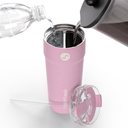
A vacuum-insulated flask can slow heat loss, but it cannot sterilize milk or guarantee that a drink stays outside the food-safety “danger zone.” For a latte, café au lait, or hot chocolate, time and measured temperature matter more than whether the outside of the vessel still feels warm.
Is hot milk safe in an insulated flask?
It can be, provided the vessel is approved for hot liquids and the milk stays hot enough. The U.S. Department of Agriculture advises keeping hot food at 140°F or above and cold food at 40°F or below. Perishable food held between those temperatures should generally be discarded after two hours, or after one hour when the ambient temperature is above 90°F.
That clock is cumulative. Time spent cooling on the counter, riding in a warm car, and sitting in the flask all counts. Smell and appearance cannot reliably tell you whether harmful bacteria have multiplied.
Practical rule: If you cannot verify that the drink has remained at least 140°F, drink it within two hours of preparation—or one hour in temperatures above 90°F—and discard the remainder.
How to pack a latte safely
- Check the vessel. Confirm that the bottle, lid, seals, and drinking opening are approved for hot liquids at the temperature you plan to use.
- Start clean. Wash and rinse every milk-contact surface before filling.
- Preheat if the maker permits it. Warming the vessel with hot water can reduce the initial temperature drop. Empty that water completely before adding the latte.
- Fill with freshly prepared drink. Leave the required headspace and secure the correct lid.
- Verify, do not guess. If you plan to hold it for an extended period, use a clean food thermometer when opening it.
- Do not keep topping off old milk. Empty and wash the vessel before a new batch.
- Refrigerate or discard leftovers promptly. Do not leave a milk drink sealed at room temperature for the rest of the day.
Does milk react with stainless steel?
Food-grade stainless steel is commonly used in dairy and food-processing equipment because it is corrosion-resistant and cleanable. The more common household problems are not a chemical reaction with the steel: they are milk residue trapped in lid passages, a film left on the interior, and unsafe holding temperatures.
Check the interior before use. Deep scratches, pitting, persistent rust, or an uncleanable damaged coating are reasons to stop using the vessel for food and contact the manufacturer.
How long can a latte stay in an insulated bottle?
The safe answer depends on its actual temperature, not an advertised insulation duration. A well-performing vessel may keep a drink pleasantly warm after it has fallen below the hot-holding threshold. Those are different standards.
| Measured condition | Practical action |
|---|---|
| 140°F or hotter | Within the USDA hot-holding range; handle carefully to prevent burns |
| Between 40°F and 140°F for less than two hours | Drink promptly; shorten the window to one hour in ambient temperatures above 90°F |
| Between 40°F and 140°F beyond the applicable limit | Discard it rather than reheating or judging by smell |
| 40°F or colder | Within the cold-holding range |
How to clean milk and latte residue
Rinse as soon as practical, then wash the body and removable lid parts with warm water, mild dish soap, and a soft brush. Pay special attention to the gasket, threads, straw, and valves. Rinse until the water runs clear and air-dry every component fully with the lid off.
Follow the manufacturer's dishwasher and disassembly instructions. Do not use bleach, steel wool, or an abrasive cleaner unless the care guide expressly permits it.
Frequently asked questions
Can I leave a latte in a thermos overnight?
No. Unless it has remained at a verified safe hot- or cold-holding temperature, discard it. A sealed, insulated environment is not the same as refrigeration.
Can I reheat milk that cooled inside the bottle?
Reheating does not reliably undo unsafe time in the danger zone. If the drink exceeded the applicable two-hour or one-hour limit, discard it.
Why does my flask smell sour after a latte?
Milk proteins and fats may be trapped in the gasket or lid passages. Disassemble only as instructed, wash every removable part, and let the pieces dry separately. Replace a damaged or persistently odorous seal.
Can I use plant-based milk instead?
Prepared oat, almond, soy, and other milk alternatives are also perishable. Follow their package instructions and apply the same time-and-temperature care unless the manufacturer states otherwise.
The bottom line
A hot-liquid-approved insulated flask can carry a latte, but safe holding is a temperature question. Start hot and clean, measure when holding it for long periods, observe the USDA time limit if it enters the danger zone, and wash dairy residue out promptly.
Food-safety source: USDA Food Safety and Inspection Service, Danger Zone (40°F–140°F).